
Reviewed · PRAGUE ART TOURS
Prague Art Nouveau and Cubism Walking Tour
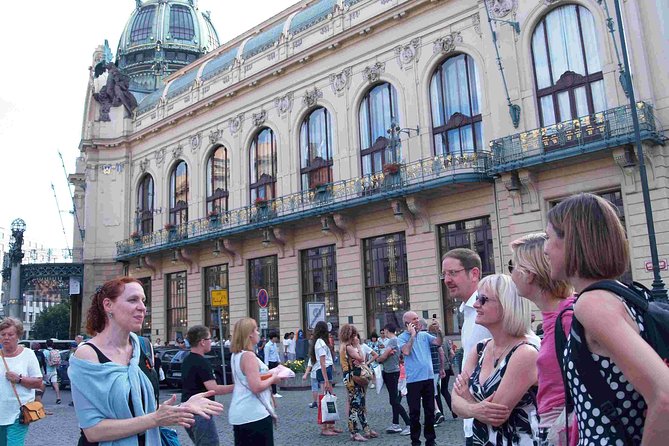
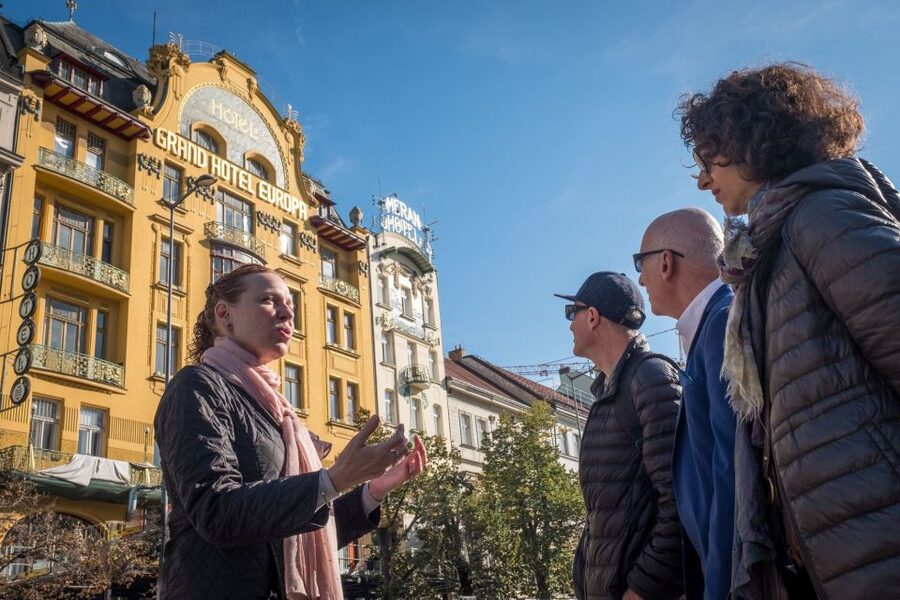
Prague’s early 20th-century architecture makes more sense when you see it as a conversation between styles and eras. On this three-hour walk, you’ll study Art Nouveau details, step into the Lucerna bar and Grand Hotel Europa, then compare the curves and ornament with the sharper forms of Cubist and Rondo-Cubist buildings.
I like two things in particular: the tour connects architecture to the people who used these places, from café regulars to early globetrotters, and it can take you inside buildings you might otherwise pass by. Guides such as Robert, Vadim, and Bonita have brought history to life with clear explanations, humor, and personal knowledge of Prague.
One consideration: this is a walking tour built around looking closely and listening, so it suits you best if architecture interests you. Guides keep the group moving, which can make photography stops feel brief. Ask for a little extra time if you want to frame your shots.
What to Know Before You Go
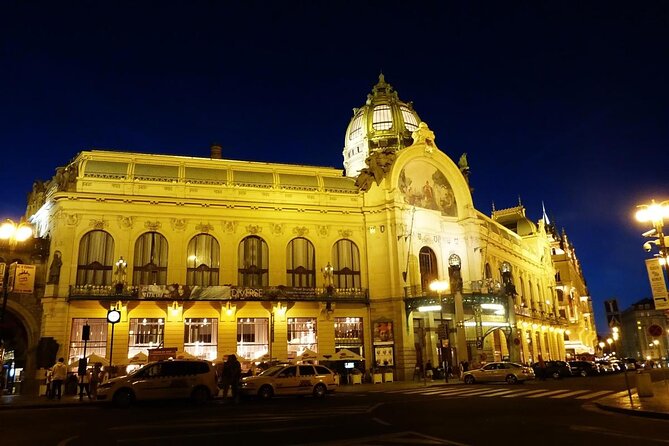
- Look for ginkgo leaves and elaborate lights: The guide points out Art Nouveau motifs on façades and inside buildings, including the style’s use of forms inspired by nature and influences from the East.
- Compare Prague’s modern styles: The walk pairs Art Nouveau with Cubist and Rondo-Cubist examples, including the House of the Black Madonna and the Bank of the Legions.
- Go inside notable buildings: The Lucerna bar and Grand Hotel Europa are named stops, offering a chance to see interiors as well as street-facing architecture.
- Hear about cafés and social life: Hotels, restaurants, bars, and stations were gathering places for the pre-war elite and the early international visitors enabled by 19th-century industrialization.
- Expect a guide-led, brisk walk: The tour lasts three hours. Past guides have kept groups moving and made breaks for coffee or restrooms when needed.
- Meet at the House of the Black Madonna: The meeting point is downstairs at the front doors, on the square, at Ovocný 19 in Prague 1.
Reading Prague Through Its Buildings
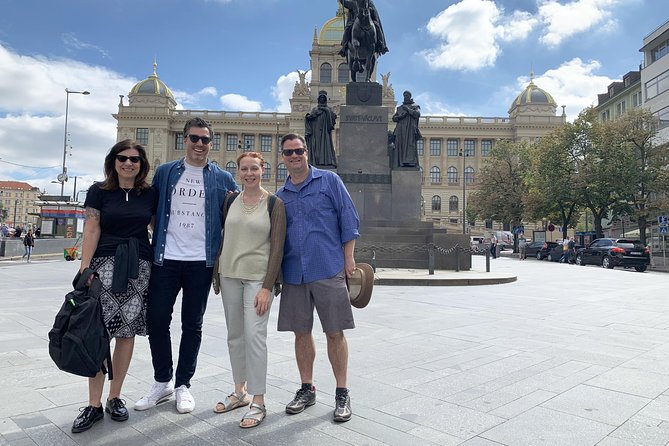
Prague is famous for its older architecture, but this tour focuses on a later moment when the city was making a modern statement. Art Nouveau and Cubism were not just decorative fashions here. They expressed a desire to join European modern life while strengthening a distinct Czech identity.
That context helps you look beyond pretty façades. When your guide draws attention to a plant motif, an angular surface, or a grand interior, you can ask what the style said about the city and the people who paid for it. The point is not to memorize a list of buildings. It is to learn how to read them.
The tour begins at the House of the Black Madonna, an important reference point for Prague Cubism and also the address of Grand Café Orient. From here, the guide can set up comparisons between the city’s architectural styles. The tour description also points to a broader progression through Prague’s architecture, with one guest recalling a route that moved from Gothic examples toward Art Nouveau. The exact emphasis may depend on the guide and the group.
That range is useful even if your main interest is Art Nouveau. Seeing a newer style in relation to older buildings makes its choices clearer. The discussion can move from Gothic forms to the modern design ideas that took hold at the turn of the 20th century, rather than treating each building as an isolated curiosity.
More art tours in Prague:
- IAM Illusion Art Museum Entry Ticket
★ 4.2 · 1,664 reviews - IAM Illusion Art Museum Prague Fast Pass Ticket
★ 5.0 · 957 reviews - Prague: Ticket to Audiovisual Light Art at Lumia Gallery
★ 4.4 · 607 reviews
Spotting Art Nouveau in Prague
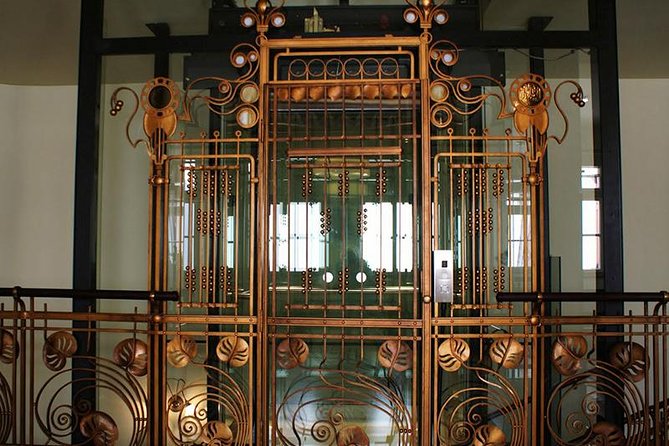
Art Nouveau grew across Europe near the end of the 19th century, and Prague took to it with enthusiasm. On the walk, you’ll learn to recognize its natural forms, ornamental details, and decorative interiors. Ginkgo biloba leaves are one example. Their use reflects the style’s interest in plant life and its broader openness to influences from the East.
Look up at façades, but don’t stop there. Art Nouveau can also be read in the details of an entrance and in the fixtures inside a building. Elaborate lighting is one of the interior features highlighted on the tour. A guide can help you notice how these elements work together, so you’re not left wondering whether a flourish is simply decoration or part of a larger design language.
A practical tip: keep your camera ready, but listen first. The tour moves through several places, and the guide’s explanation may connect one detail to a wider point about Prague’s identity. If photographs matter to you, ask for a moment to take them. The walk is not designed as a long series of stationary photo stops, and one guest specifically wished for a little more time to compose pictures.
Inside the Lucerna Bar and Grand Hotel Europa
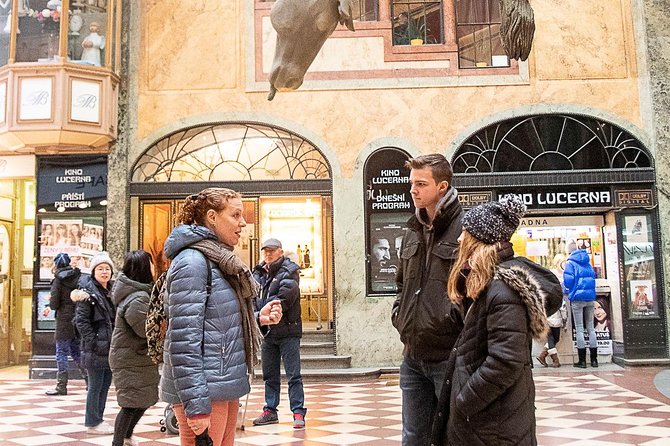
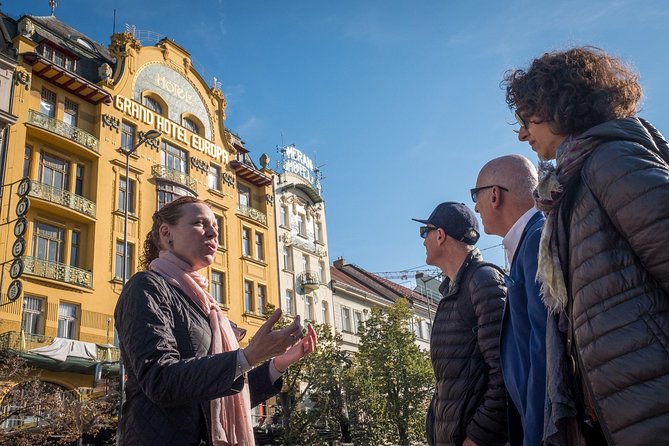
The Lucerna bar and Grand Hotel Europa bring the tour’s architectural discussion indoors. Their appeal is not limited to attractive rooms. Hotels and elegant bars were part of the social world that made Art Nouveau buildings matter: places where people met, traveled, ate, and took part in a new, more mobile urban life.
The guide can help you notice the interior details that are easy to miss when you enter only to admire the overall effect. Lighting, ornament, and the relationship between a room’s decorative features all help explain the style. These visits also offer a welcome change from studying façades on the street, and, in cold weather, indoor stops can provide a brief warm-up.
The tour describes visits to these two buildings, but access to historic interiors can depend on circumstances beyond the tour itself. Keep an open mind about how long you may spend inside each place. The aim is to see and understand, not to linger indefinitely in every room.
The wider social story adds substance to the visit. In the years before the First World War, the city’s hotels, restaurants, bars, and stations served people who were enjoying the effects of industrialization and expanded travel. The tour places these buildings in that setting, before the war brought that world to an abrupt end.
Comparing Cubist and Rondo-Cubist Architecture
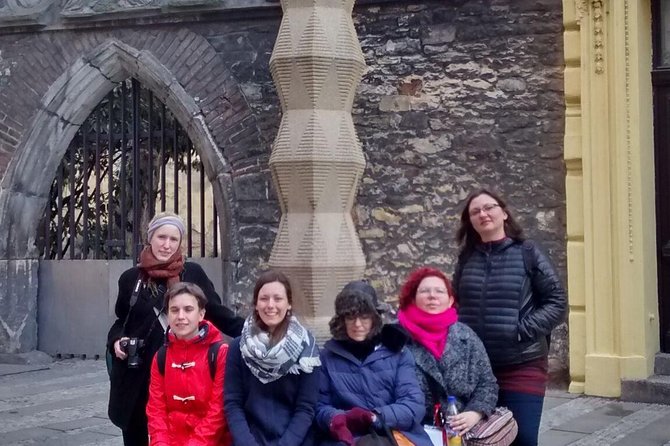
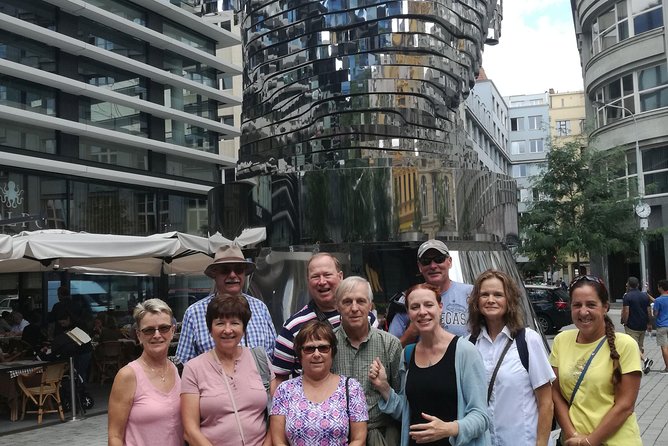
Prague’s Cubist buildings give the walk a useful counterpoint to Art Nouveau. Instead of focusing on flowing plant forms and decorative detail, Cubist architecture plays with angular shapes and a more fractured sense of form. The House of the Black Madonna is a key example, and the Bank of the Legions provides another point of comparison.
Rondo-Cubism adds a further chapter to the story. The tour uses these styles to show how Prague’s architecture changed as the city expressed its modern ambitions and national identity. You don’t need prior knowledge of art history to follow the discussion. The guide’s job is to point out what to notice and explain why a building’s shapes matter.
That makes this tour more rewarding than a simple checklist of famous façades. A strong guide can connect the design to the period’s social and political currents, then return to the physical evidence in front of you. Past guides have been praised for making these links clear and for answering questions without turning the walk into a lecture.
More walking tours in Prague:
- Prague: 3-Hour Walking Tour of Old Town & Prague Castle
★ 4.7 · 5,696 reviews - Prague: Ghost Walking Tour Where Legends Come To Life
★ 4.4 · 5,253 reviews - Prague: Jewish Quarter Walking Tour with Admission Tickets
★ 4.7 · 3,729 reviews - Prague Guided Walking Tour and Cruise with Authentic Czech Lunch
★ 5.0 · 3,627 reviews
The Guide Makes the Difference
The tour’s guides have included Robert, Vadim, and Bonita. The activity is led in English, and guides are drawn from backgrounds including university teaching and research, history, journalism, art criticism, and publishing. The individual guide can vary, so you should not book expecting a particular person unless that can be confirmed when you reserve.
The guide’s role matters because this is a detail-focused walk. Robert has been described as an engaging storyteller who answers questions with knowledge and humor. Vadim has been praised for putting architecture into a wider historical frame. Bonita has been noted for finding architectural details and interiors that are easy to miss when exploring alone.
The pace is another practical feature. Rather than standing still for long stretches, guides tend to keep the group moving. That can be easier on your feet than a series of lengthy talks in one spot, though it may not suit you if you like to photograph every building at leisure. One guide has also adjusted for coffee and restroom breaks when needed, so don’t hesitate to speak up about basic comfort.
Some tours may also include lesser-known places and interior spaces beyond the named architectural stops. Past outings have included places such as a university hall, a chapel, cafés in courtyards, passages, and sites with Roman remains or frescoes. These should be treated as possibilities, not guaranteed stops; the advertised focus remains Art Nouveau, Cubism, and Prague’s architectural history.
Is Three Hours and $123 Good Value?
At $123 per person, this is a substantial spend for a three-hour walk. The value depends on what you want from Prague. If you mainly want a quick overview of famous sights, a general city tour may give you more variety for less. If you want expert interpretation, access to interiors, and a focused look at architecture you might not recognize on your own, the higher price is easier to justify.
A private or small-group format is available. Smaller groups can make it easier to ask questions and hear the guide, and they may allow the discussion to follow your interests. The exact group arrangement can vary, so check the available option when you book.
The practical terms are flexible: you can reserve now and pay later, and cancellation is free up to 24 hours in advance for a full refund. Starting times depend on availability. The tour lasts three hours, so avoid scheduling a tight appointment immediately afterward. One guide has asked at the outset whether the group needed to be elsewhere, and the walk may run longer if everyone wants to continue. Confirm your timing with the guide rather than assuming an extension.
The meeting point is specific: the front doors downstairs at the House of the Black Madonna / Grand Café Orient, on the square, Ovocný 19, Prague 1. Arrive ready to walk and look closely. The supplied information does not specify accessibility details, so ask the provider directly if steps, walking distance, or access to interiors are a concern.
Who Should Book This Walk?
I’d choose this tour if you enjoy architecture, want to understand Prague beyond its best-known older monuments, or like a guide who can connect design with social history. It also suits repeat visitors: even if you have already explored the city once, the interiors, passages, and architectural details can offer a different way to see familiar streets.
It is less suited to you if you want a slow photo walk, prefer minimal commentary, or have only a short time and need a broad survey of the city. The three-hour format is focused, and the best return comes when you are curious enough to stop, look up, and compare styles.
For a traveler who wants Prague’s Art Nouveau and Cubist architecture explained rather than merely pointed out, this is a strong choice. Book it if those styles interest you and you value a guide’s interpretation. If you are unsure, consider whether you would rather spend three hours learning how buildings tell a story or covering more ground at a faster sightseeing pace.
FAQ
How long is the Prague Art Nouveau and Cubism Walking Tour?
The guided walking tour lasts three hours. Starting times vary, so check availability when booking.
What language is the tour in?
The tour is offered in English.
Where is the meeting point?
Meet downstairs at the front doors of the House of the Black Madonna / Grand Café Orient, on the square at Ovocný 19, Prague 1.
Which buildings are included?
The tour highlights the Lucerna bar and Grand Hotel Europa, and compares Prague’s Art Nouveau with Cubist and Rondo-Cubist examples such as the House of the Black Madonna and the Bank of the Legions.
Is the tour private or in a group?
Private or small-group options are available. Check the booking options for the format offered on your date.
Who leads the tour?
The guides are English-speaking and come from backgrounds that include teaching, research, history, journalism, art criticism, and writing. Guides have included Robert, Vadim, and Bonita, but the individual guide may vary.
Can I cancel for a refund?
Yes. You can cancel up to 24 hours in advance for a full refund.
Do I have to pay when I reserve?
No. The reserve-now, pay-later option lets you book without paying immediately.
Newly listed in Prague
- The only full Anthropoid tour with a visit to curve and Lidice, by private car★ 5.0 · 30 reviews
- Stand-Up Paddleboarding on the Vltava River in Prague★ 5.0 · 63 reviews
- Prague E-Bike City Sightseeing Tour★ 5.0 · 3 reviews
- Private UNESCO Český Krumlov Trip from Prague with Local Guide★ 5.0 · 32 reviews
- One Prague Tour: Old Town Road with local Food & Beer ️★ 5.0 · 137 reviews
- Full-Day Countryside E-Bike Tour to Karlstejn Castle (small group★ 5.0 · 40 reviews
- Historical Prague – Walking Tour with pick up★ 4.5 · 5 reviews
- One Hour Boat Tour on Vltava River★ 3.0 · 20 reviews
Prague Art Tours, compared.
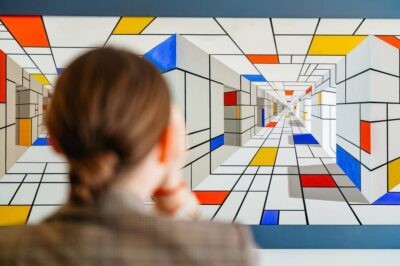
IAM Illusion Art Museum Prague Fast Pass Ticket
Read our review →
Ticket to Audiovisual Light Art at Lumia Gallery
Read our review →

Alternative bar tour with dinner in the art district
Read our review →
Choco Art Museum Ticket with Chocolate Making Class
Read our review →
Browse the lists this tour appears in